


Object Details
Catalogue Note
A compact Japanese bronze Buddha from the early 20th century, seated in dhyana mudra. Although modest in size, the figure has a broad, rounded volume and a restrained frontal presence.
The hands rest one above the other in the lap, forming the meditation gesture associated with inner concentration. The face is defined by lowered eyes, a small closed mouth and a raised urna at the centre of the forehead. The hair is arranged in regular rows of individually marked curls, creating a strongly graphic treatment around the head.
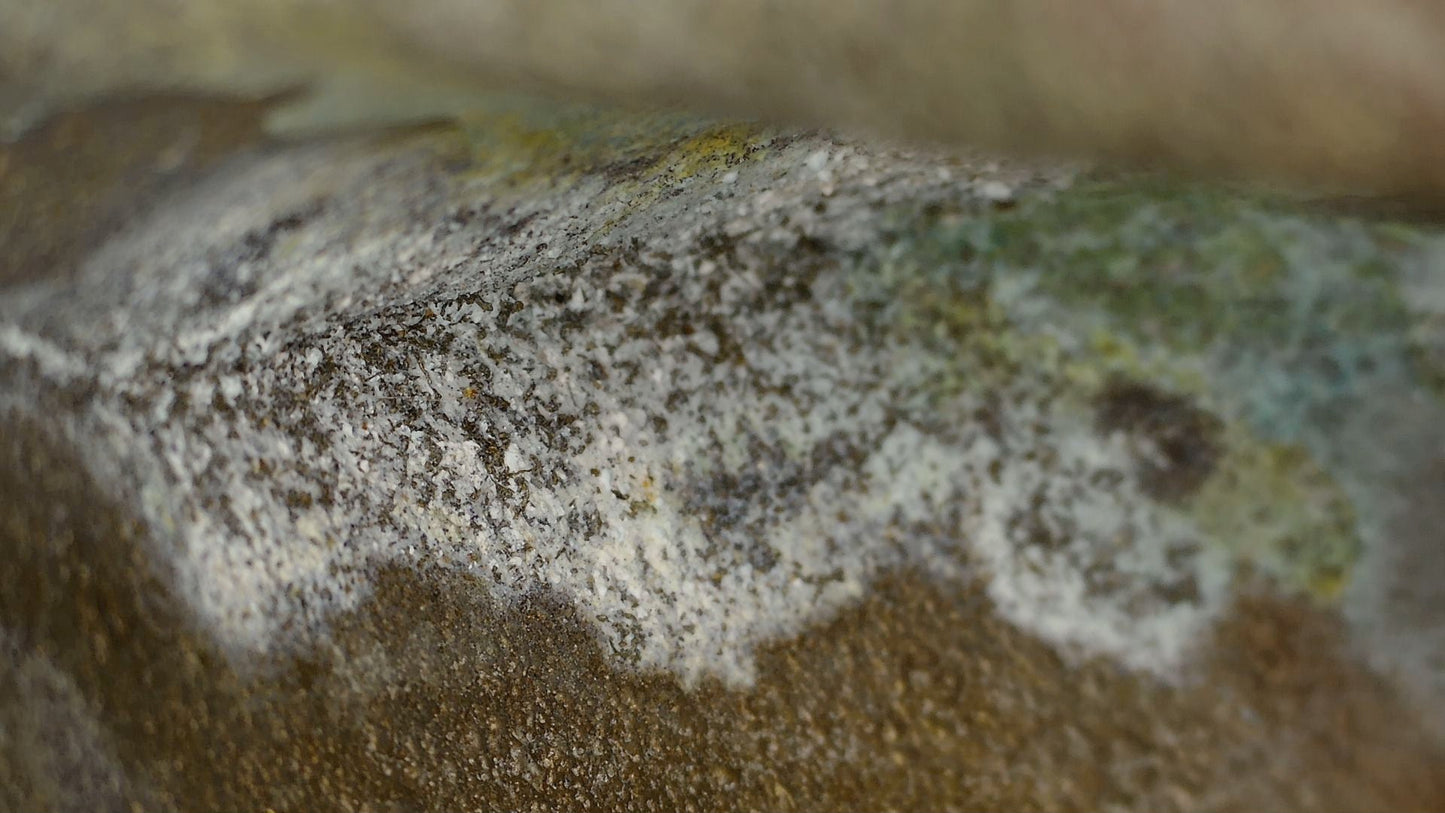
The monastic robe falls in deeply incised parallel folds over both shoulders and continues across the lap. These recessed lines retain extensive green copper oxidation, contrasting with the smoother reddish-brown bronze visible on the chest, arms, knees and back.
The sculpture was hollow cast and remains open underneath. The interior exposes the thickness of the casting, the worked lower edge and old deposits within the cavity. The macro photographs document the surface, casting rim and internal construction in detail.
Details
- Age / Period: Early 20th century
- Material: Hollow-cast bronze / copper alloy
- Dimensions: H 12.5 × W 10.5 cm
- Weight: 1 kg
- Mudra: Dhyana mudra
- Origin: Japan
- Construction: Hollow cast, open underside
Technical Observations
The open base provides a clear view of the interior casting surface and wall thickness. Fine parallel tooling marks are visible along parts of the lower rim. Green copper oxidation and pale deposits occur both on the exterior and within the recessed areas, while the principal exposed surfaces retain a dark reddish-brown tone.
Condition
Wear, surface variation, deposits and local copper oxidation consistent with age. The underside remains open and has small protective felt pads attached at the rim. No structural break is visible in the supplied photographs. Please examine all overall and macro images, which form an integral part of the condition description.
