


Object Details
Catalogue Note
Dating from the first half of the 20th century, this finely cast Nepalese bronze depicts the Buddha in his role as teacher. Seated in meditation upon a stylised lotus pedestal, the Buddha raises his right hand in Vitarka Mudra, the gesture associated with teaching, intellectual discussion and the transmission of Buddhist wisdom. His left hand rests open in the lap in Dhyana Mudra, expressing meditation and inner balance.
The sculpture is particularly distinguished by its richly worked monastic robe. Flowing folds and incised vegetal ornament continue around the shoulders and across the back, giving the figure visual interest from every angle. The composed face, elongated earlobes, urna, tightly arranged hair curls and prominent ushnisha follow established Himalayan Buddhist iconography.
The Buddha is supported by an oval lotus base with a continuous band of broad petals. Together with the compact proportions and substantial weight, this gives the sculpture a balanced and grounded presence despite its relatively modest size.
Surface and Casting
The bronze displays a naturally varied brown patina. Raised areas—including the face, hands, robe and edges of the lotus petals—show lighter wear, while darker colour remains within the recessed decoration. This contrast makes the modelling and incised ornament especially legible.
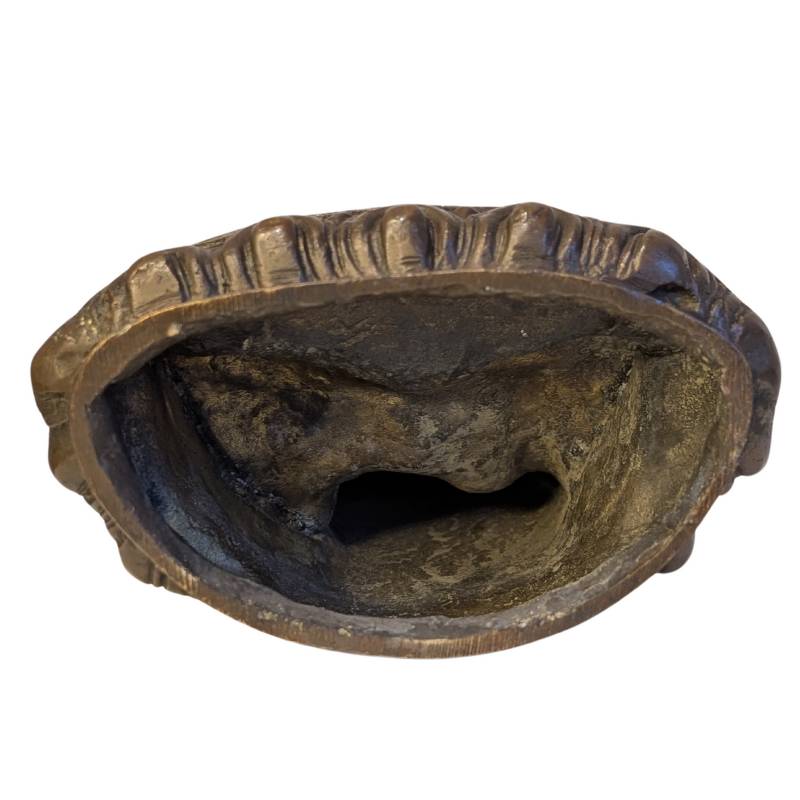
The open underside reveals the irregular interior of the hollow casting, including surviving casting material and a rough, non-mechanically finished surface. These features are consistent with traditional lost-wax manufacture and form an important part of the object’s material history.
Object Details
- Origin: Nepal
- Period: First half of the 20th century
- Approximate date: Circa 1900–1950
- Dimensions: H 17.5 × W 12 cm
- Weight: Approximately 1 kg
- Material: Cast bronze
- Primary mudra: Vitarka Mudra — teaching and discussion
- Secondary mudra: Dhyana Mudra — meditation
Condition
Good condition with natural surface wear, tonal variation, local oxidation and minor casting irregularities consistent with the object’s age and traditional manufacture. The underside remains open and preserves the rough casting interior. Please examine all photographs, which form an integral part of the condition description.
