


Object Details
Catalogue Note
An exceptionally refined bronze Buddha from Northern Thailand, belonging to the artistic sphere in which Northern Sukhothai and Lan Na traditions converged during the late 15th and early 16th centuries.
The Buddha is seated in bhumisparsha mudra, calling the earth to witness his enlightenment. The sculpture is distinguished by its elegant proportions, elongated torso, finely modelled face, aquiline nose, delicately drawn mouth and exceptionally controlled downcast eyes.
Of particular importance are the original composite eye inlays. Microscopic examination shows aged bone forming the pale eye elements, combined with separate green glass inserts. This unusual construction is preserved within an old dark setting material and represents one of the most remarkable technical features of the sculpture.
The figure was hollow cast using the lost-wax process. The open underside preserves substantial remains of the original clay core together with irregular internal casting surfaces and old copper-alloy corrosion. These features provide unusually clear evidence of the historic casting process.
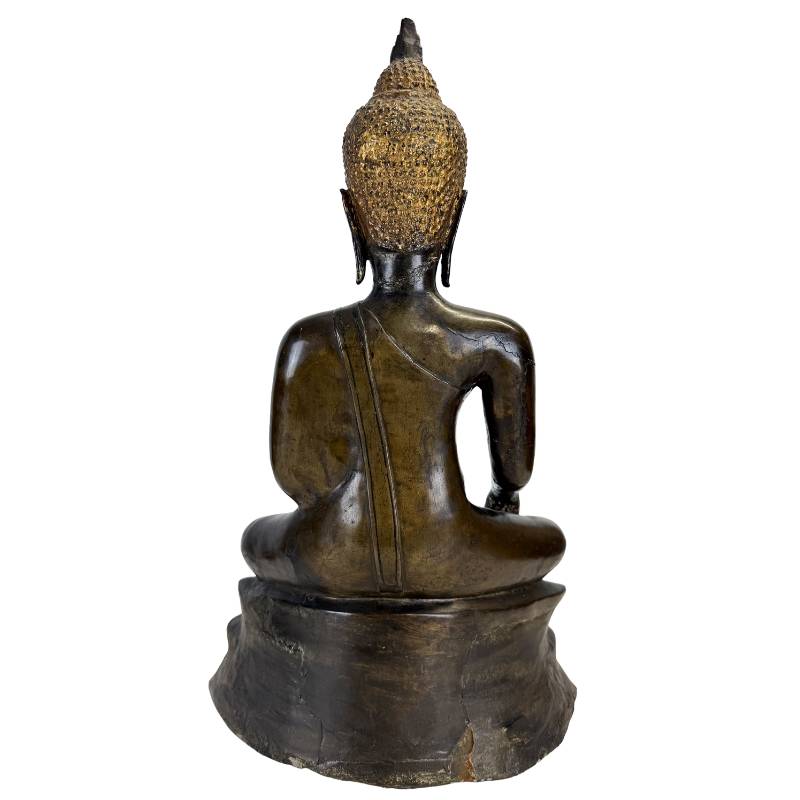
The tightly arranged hair curls retain extensive traces of old gold leaf over a dark lacquer or preparation layer. The treatment differs markedly from later coarse curl patterns and forms an important part of the sculpture's early stylistic character.
Details
- Age / Period: Late 15th – early 16th century, circa 1480–1520
- Material: Hollow-cast bronze / copper alloy, bone and green glass eye inlays, lacquer and gold-leaf remains
- Dimensions: H 47.5 × W 29.5 cm
- Weight: 7 kg
- Mudra: Bhumisparsha mudra
- Origin: Northern Thailand
- Attribution: Northern Sukhothai–Lan Na tradition, probably related to an early Fang / Chiang Mai workshop
Technical Observations
The sculpture retains extensive evidence of its original manufacture, including a substantial clay casting core, irregular lost-wax casting surfaces, old internal oxidation, composite eye inlays and surviving lacquer-gilded decoration. Microscopic examination revealed no indication that the unusual bone and green-glass eye construction is a modern decorative addition.
Condition
Wear, fissures, surface oxidation and losses consistent with considerable age. Gilding survives principally in the hair. The eye inlays show age-related wear and minor losses. No significant modern reconstruction observed during examination.
